President Barack Obama has been trying, mostly in secret, to craft a new foreign policy that relies heavily on cooperation with Russian President Vladimir Putin to tamp down confrontations in hotspots such as Iran and Syria. But Obama’s timidity about publicly explaining this strategy has left it open to attack from powerful elements of Official Washington, including well-placed neocons and people in his own administration.
The gravest threat to this Obama-Putin collaboration has now emerged in Ukraine, where a coalition of U.S. neocon operatives and neocon holdovers within the State Department fanned the flames of unrest in Ukraine, contributing to the violent overthrow of democratically elected President Viktor Yanukovych and now to a military intervention by Russian troops in the Crimea, a region in southern Ukraine that historically was part of Russia.
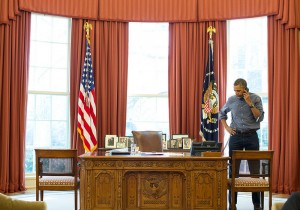 resident Barack Obama discusses the crisis in Ukraine for 90 minutes on March 1, 2014, with Russian President Vladimir Putin. (White House photo/Pete Souza)
Though I’m told the Ukraine crisis caught Obama and Putin by surprise, the neocon determination to drive a wedge between the two leaders has been apparent for months, especially after Putin brokered a deal to head off U.S. military strikes against Syria last summer and helped get Iran to negotiate concessions on its nuclear program, both moves upsetting the neocons who had favored heightened confrontations.
Putin also is reported to have verbally dressed down Israel’s Prime Minister Benjamin Netanyahu and then-Saudi intelligence chief Prince Bandar bin Sultan over what Putin considered their provocative actions regarding the Syrian civil war. So, by disrupting neocon plans and offending Netanyahu and Bandar, the Russian president found himself squarely in the crosshairs of some very powerful people.
If not for Putin, the neocons – along with Israel and Saudi Arabia – had hoped that Obama would launch military strikes on Syria and Iran that could open the door to more “regime change” across the Middle East, a dream at the center of neocon geopolitical strategy since the 1990s. This neocon strategy took shape after the display of U.S. high-tech warfare against Iraq in 1991 and the collapse of the Soviet Union later that year. U.S. neocons began believing in a new paradigm of a uni-polar world where U.S. edicts were law.
The neocons felt this paradigm shift also meant that Israel would no longer need to put up with frustrating negotiations with the Palestinians. Rather than haggling over a two-state solution, U.S. neocons simply pressed for “regime change” in hostile Muslim countries that were assisting the Palestinians or Lebanon’s Hezbollah.
Iraq was first on the neocon hit list, but next came Syria and Iran. The overriding idea was that once the regimes assisting the Palestinians and Hezbollah were removed or neutralized, then Israel could dictate peace terms to the Palestinians who would have no choice but to accept what was on the table.
U.S. neocons working on Netanyahu’s campaign team in 1996, including Richard Perle and Douglas Feith, even formalized their bold new plan, which they outlined in a strategy paper, called “A Clean Break: A New Strategy for Securing the Realm.” The paper argued that only “regime change” in hostile Muslim countries could achieve the necessary “clean break” from the diplomatic standoffs that had followed inconclusive Israeli-Palestinian peace talks.
In 1998, the neocon Project for the New American Century called for a U.S. invasion of Iraq, but President Bill Clinton refused to go along. The situation changed, however, when President George W. Bush took office and after the 9/11 attacks. Suddenly, the neocons had a Commander in Chief who agreed with the need to eliminate Iraq’s Saddam Hussein — and a stunned and angry U.S. public could be easily persuaded. [See Consortiumnews.com’s “
The Mysterious Why of the Iraq War.”]
So, Bush invaded Iraq, ousting Hussein but failing to subdue the country. The U.S. death toll of nearly 4,500 soldiers and the staggering costs, estimated to exceed $1 trillion, made the American people and even Bush unwilling to fulfill the full-scale neocon vision, which was expressed in one of their favorite jokes of 2003 about where to attack next, Iran or Syria, with the punch line: “Real men go to Tehran!”
Though hawks like Vice President Dick Cheney pushed the neocon/Israeli case for having the U.S. military bomb Iran’s nuclear facilities – with the hope that the attacks also might spark a “regime change” in Tehran – Bush decided that he couldn’t risk the move, especially after the U.S. intelligence community assessed in 2007 that Iran had stopped work on a bomb four years earlier.
The Rise of Obama
The neocons were dealt another setback in 2008 when Barack Obama defeated a neocon favorite, Sen. John McCain. But Obama then made one of the fateful decisions of his presidency, deciding to staff key foreign-policy positions with “a team of rivals,” i.e. keeping Republican operative Robert Gates at the Defense Department and recruiting Hillary Clinton, a neocon-lite, to head the State Department.
Obama also retained Bush’s high command, most significantly the media-darling Gen. David Petraeus. That meant that Obama didn’t take control over his own foreign policy.
Gates and Petraeus were themselves deeply influenced by the neocons, particularly Frederick Kagan, who had been a major advocate for the 2007 “surge” escalation in Iraq, which was hailed by the U.S. mainstream media as a great “success” but never achieved its principal goal of a unified Iraq. At the cost of nearly 1,000 U.S. dead, it only bought time for an orderly withdrawal that spared Bush and the neocons the embarrassment of an obvious defeat.
So, instead of a major personnel shakeup in the wake of the catastrophic Iraq War, Obama presided over what looked more like continuity with the Bush war policies, albeit with a firmer commitment to draw down troops in Iraq and eventually in Afghanistan.
From the start, however, Obama was opposed by key elements of his own administration, especially at State and Defense, and by the still-influential neocons of Official Washington. According to various accounts, including Gates’s new memoir Duty, Obama was maneuvered into supporting a troop “surge” in Afghanistan, as advocated by neocon Frederick Kagan and pushed by Gates, Petraeus and Clinton.
Gates wrote that Kagan persuaded him to recommend the Afghan “surge” and that Obama grudgingly went along although Gates concluded that Obama didn’t believe in the “mission” and wanted to reverse course more quickly than Gates, Petraeus and their side wanted.
Faced with this resistance from his own bureaucracy, Obama began to rely on a small inner circle built around Vice President Joe Biden and a few White House advisers with the analytical support of some CIA officials, including CIA Director Leon Panetta.
Obama also found a surprising ally in Putin after he regained the Russian presidency in 2012. A Putin adviser told me that the Russian president personally liked Obama and genuinely wanted to help him resolve dangerous disputes, especially crises with Iran and Syria.
In other words, what evolved out of Obama’s early “team of rivals” misjudgment was an extraordinary presidential foreign policy style, in which Obama developed and implemented much of his approach to the world outside the view of his secretaries of State and Defense (except when Panetta moved briefly to the Pentagon).
Even after the eventual departures of Gates in 2011, Petraeus as CIA director after a sex scandal in late 2012, and Clinton in early 2013, Obama’s peculiar approach didn’t particularly change. I’m told that he has a distant relationship with Secretary of State John Kerry, who never joined Obama’s inner foreign policy circle.
Though Obama’s taciturn protectiveness of his “real” foreign policy may be understandable given the continued neocon “tough-guy-ism” that dominates Official Washington, Obama’s freelancing approach gave space to hawkish elements of his own administration.
For instance, Secretary of State Kerry came close to announcing a U.S. war against Syria in a bellicose speech on Aug. 30, 2013, only to see Obama pull the rug out from under him as the President worked with Putin to defuse the crisis sparked by a disputed chemical weapons attack outside Damascus. [See Consortiumnews.com’s “
How War on Syria Lost Its Way.”]
Similarly, Obama and Putin hammered out the structure for an interim deal with Iran on how to constrain its nuclear program. But when Kerry was sent to seal that agreement in Geneva, he instead inserted new demands from the French (who were carrying water for the Saudis) and nearly screwed it all up. After getting called on the carpet by the White House, Kerry returned to Geneva and finalized the arrangements.[See Consortiumnews.com’s “
A Saudi-Israel Defeat on Iran Deal.”]
Unorthodox Foreign Policy
Obama’s unorthodox foreign policy – essentially working in tandem with the Russian president and sometimes at odds with his own foreign policy bureaucracy – has forced Obama into faux outrage when he’s faced with some perceived affront from Russia, such as its agreement to give temporary asylum to National Security Agency whistleblower Edward Snowden.
For the record, Obama had to express strong disapproval of Snowden’s asylum, though in many ways Putin was doing Obama a favor by sparing Obama from having to prosecute Snowden with the attendant complications for U.S. national security and the damaging political repercussions from Obama’s liberal base.
Putin’s unforced errors also complicated the relationship, such as when he defended Russian hostility toward gays and cracked down on dissent before the Sochi Olympics. Putin became an easy target for U.S. commentators and comedians.
But Obama’s hesitancy to explain the degree of his strategic cooperation with Putin has enabled Official Washington’s still influential neocons, including holdovers within the State Department bureaucracy, to drive more substantive wedges between Obama and Putin. The neocons came to recognize that the Obama-Putin tandem had become a major impediment to their strategic vision.
Without doubt, the neocons’ most dramatic – and potentially most dangerous – counter-move has been Ukraine, where they have lent their political and financial support to opposition forces who sought to break Ukraine away from its Russian neighbor.
Though this crisis also stems from the historical division of Ukraine – between its more European-oriented west and the Russian-ethnic east and south – neocon operatives, with financing from the U.S.-funded National Endowment for Democracy and other U.S. sources, played key roles in destabilizing and overthrowing the democratically elected president.
NED, a $100 million-a-year agency created by the Reagan administration in 1983 to promote political action and psychological warfare against targeted states, lists 65 projects that it supports financially inside Ukraine, including training activists, supporting “journalists” and promoting business groups, effectively creating a full-service structure primed and ready to destabilize a government in the name of promoting “democracy.” [See Consortiumnews.com’s “
A Shadow US Foreign Policy.”]
State Department neocons also put their shoulders into shoving Ukraine away from Russia. Assistant Secretary of State for European Affairs Victoria Nuland, the wife of prominent neocon Robert Kagan and the sister-in-law of the Gates-Petraeus adviser Frederick Kagan, advocated strenuously for Ukraine’s reorientation toward Europe.
Last December, Nuland
reminded Ukrainian business leaders that, to help Ukraine achieve “its European aspirations, we have invested more than $5 billion.” She said the U.S. goal was to take “Ukraine into the future that it deserves,” by which she meant into the West’s orbit and away from Russia’s.
But President Yanukovych rejected a European Union plan that would have imposed harsh austerity on the already impoverished Ukraine. He accepted a more generous $15 billion loan from Russia, which also has propped up Ukraine’s economy with discounted natural gas. Yanukovych’s decision sparked anti-Russian street protests in Kiev, located in the country’s western and more pro-European region.
Nuland was soon at work planning for “regime change,” encouraging disruptive street protests by personally passing out cookies to the anti-government demonstrators. She didn’t seem to notice or mind that the protesters in Kiev’s Maidan square had hoisted a large banner honoring Stepan Bandera, a Ukrainian nationalist who collaborated with the German Nazis during World War II and whose militias participated in atrocities against Jews and Poles.
By late January, Nuland was discussing with U.S. Ambassador to Ukraine Geoffrey Pyatt who should be allowed in the new government.
“Yats is the guy,” Nuland said in a phone call to Pyatt that was intercepted and posted online. “He’s got the economic experience, the governing experience. He’s the guy you know.” By “Yats,” Nuland was referring to Arseniy Yatsenyuk, who had served as head of the central bank, foreign minister and economic minister — and who was committed to harsh austerity.
As Assistant Secretary Nuland and Sen. McCain cheered the demonstrators on, the street protests turned violent. Police clashed with neo-Nazi bands, the ideological descendants of Bandera’s anti-Russian Ukrainians who collaborated with the Nazi SS during World War II.
With the crisis escalating and scores of people killed in the street fighting, Yanukovych agreed to a E.U.-brokered deal that called for moving up scheduled elections and having the police stand down. The neo-Nazi storm troopers then seized the opening to occupy government buildings and force Yanukovych and many of his aides to flee for their lives.
With these neo-Nazis providing “security,” the remaining parliamentarians agreed in a series of unanimous or near unanimous votes to establish a new government and seek Yanukovych’s arrest for mass murder. Nuland’s choice, Yatsenyuk, emerged as interim prime minister.
Yet, the violent ouster of Yanukovych provoked popular resistance to the coup from the Russian-ethnic south and east. After seeking refuge in Russia, Yanukovych appealed to Putin for help. Putin then dispatched Russian troops to secure control of the Crimea. [For more on this history, see Consortiumnews.com’s “
Cheering a ‘Democratic’ Coup in Ukraine.”]
Separating Obama from Putin
The Ukraine crisis has given Official Washington’s neocons another wedge to drive between Obama and Putin. For instance, the neocon flagship Washington Post editorialized on Saturday that Obama was responding “with phone calls” when something much more threatening than “condemnation” was needed.
It’s always stunning when the Post, which so energetically lobbied for the U.S. invasion of Iraq under the false pretense of eliminating its (non-existent) weapons of mass destruction, gets its ire up about another country acting in response to a genuine security threat on its own borders, not half a world away.
But the Post’s editors have never been deterred by their own hypocrisy. They wrote, “Mr. Putin’s likely objective was not difficult to figure. He appears to be responding to Ukraine’s overthrow of a pro-Kremlin government last week with an old and ugly Russian tactic: provoking a separatist rebellion in a neighboring state, using its own troops when necessary.”
The reality, however, appears to have been that neocon elements from within the U.S. government encouraged the overthrow of the elected president of Ukraine via a coup spearheaded by neo-Nazi storm troopers who then terrorized lawmakers as the parliament passed draconian laws, including some intended to punish the Russian-oriented regions which favor Yanukovych.
Yet, besides baiting Obama over his tempered words about the crisis, the Post declared that “Mr. Obama and European leaders must act quickly to prevent Ukraine’s dismemberment. Missing from the president’s statement was a necessary first step: a demand that all Russian forces – regular and irregular – be withdrawn … and that Moscow recognize the authority of the new Kiev government. … If Mr. Putin does not comply, Western leaders should make clear that Russia will pay a heavy price.”
The Post editors are fond of
calling for ultimatums against various countries, especially Syria and Iran, with the implication that if they don’t comply with some U.S. demand that harsh actions, including military reprisals, will follow.
But now the neocons, in their single-minded pursuit of endless “regime change” in countries that get in their way, have taken their ambitions to a dangerous new level, confronting nuclear-armed Russia with ultimatums.
By Sunday, the Post’s neocon editors were “spelling out the consequences” for Putin and Russia, essentially proposing a new Cold War. The Post mocked Obama for alleged softness toward Russia and suggested that the next “regime change” must come in Moscow.
“Many in the West did not believe Mr. Putin would dare attempt a military intervention in Ukraine because of the steep potential consequences,” the Post wrote. “That the Russian ruler plunged ahead shows that he doubts Western leaders will respond forcefully. If he does not quickly retreat, the United States must prove him wrong.”
The madness of the neocons has long been indicated by their extraordinary arrogance and their contempt for other nations’ interests. They assume that U.S. military might and other coercive means must be brought to bear on any nation that doesn’t bow before U.S. ultimatums or that resists U.S.-orchestrated coups.
Whenever the neocons meet resistance, they don’t rethink their strategy; they simply take it to the next level. Angered by Russia’s role in heading off U.S. military attacks against Syria and Iran, the neocons escalated their geopolitical conflict by taking it to Russia’s own border, by egging on the violent ouster of Ukraine’s elected president.
The idea was to give Putin an embarrassing black eye as punishment for his interference in the neocons’ dream of “regime change” across the Middle East. Now, with Putin’s countermove, his dispatch of Russian troops to secure control of the Crimea, the neocons want Obama to further escalate the crisis by going after Putin.
Some leading neocons even see ousting Putin as a crucial step toward reestablishing the preeminence of their agenda. NED president Carl Gershman
wrote in the Washington Post, “Ukraine’s choice to join Europe will accelerate the demise of the ideology of Russian imperialism that Putin represents. … Russians, too, face a choice, and Putin may find himself on the losing end not just in the near abroad but within Russia itself.”
At minimum, the neocons hope that they can neutralize Putin as Obama’s ally in trying to tamp down tensions with Syria and Iran – and thus put American military strikes against those two countries back under active consideration.
As events spin out of control, it appears way past time for President Obama to explain to the American people why he has collaborated with President Putin in trying to resolve some of the world’s thorniest problems.
That, however, would require him to belatedly take control of his own administration, to purge the neocon holdovers who have worked to sabotage his actual foreign policy, and to put an end to neocon-controlled organizations, like the National Endowment for Democracy, that use U.S. taxpayers’ money to stir up trouble abroad. That would require real political courage.
This work is licensed under a Creative Commons Attribution-Share Alike 3.0 License.


